
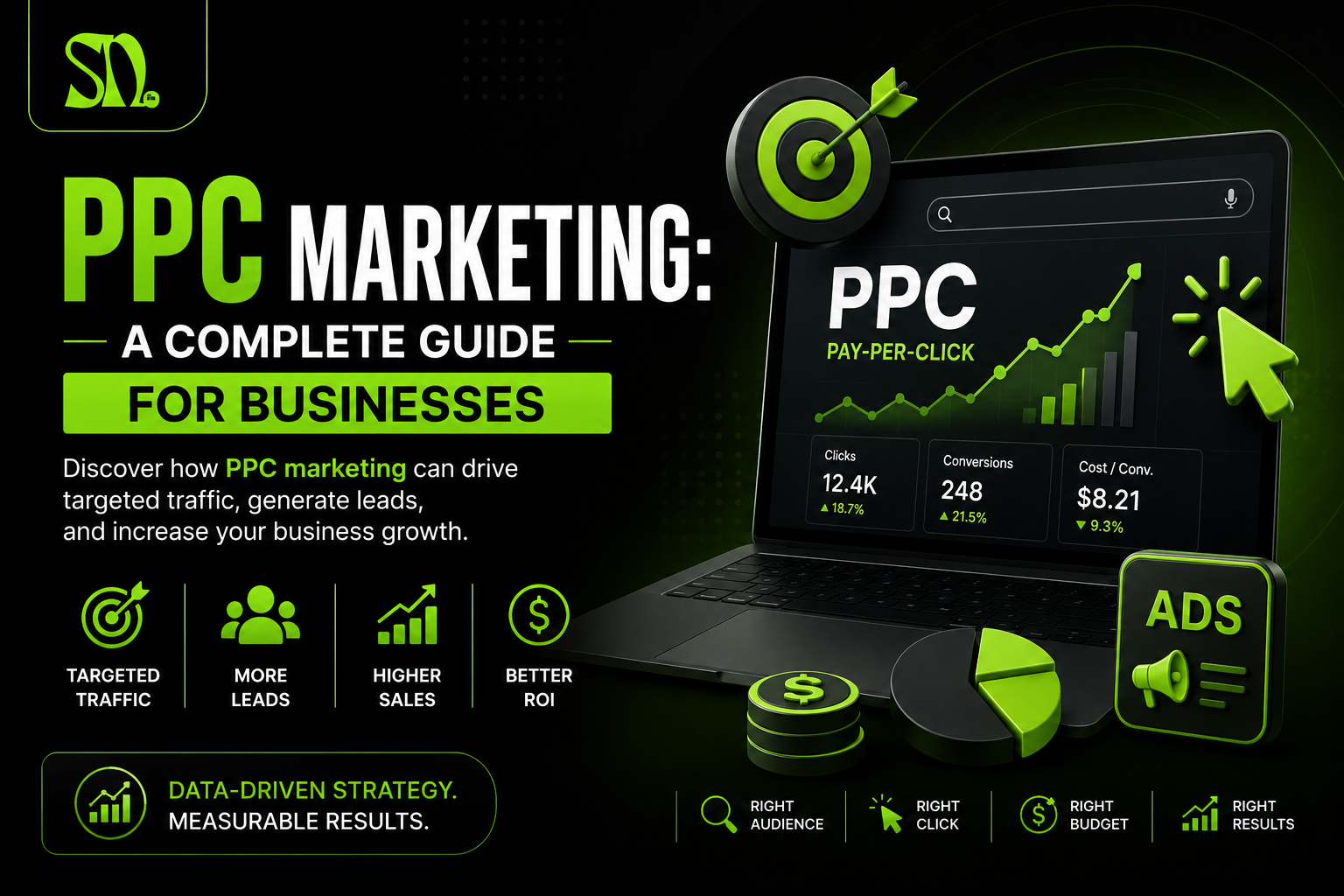
In today’s competitive digital landscape, businesses need effective ways to reach potential customers and generate measurable results. PPC marketing is one of the most effective digital advertising strategies for businesses that want to increase website traffic, generate leads, and drive sales.
Whether you run a small business, an e-commerce store, or a growing company, understanding how PPC marketing works can help you make better decisions about your advertising budget.
What Is PPC Marketing?
PPC marketing, short for pay-per-click marketing, is a form of digital advertising where businesses pay a fee when someone clicks on their advertisement.
Instead of waiting for customers to discover your website through organic search, PPC allows your business to appear in front of potential customers when they are actively searching for relevant products or services.
For example, a business offering web design services could create advertisements targeting keywords such as:
web design services
website development company
professional web design
affordable website design
When someone searches for one of these terms, the business’s advertisement may appear in the search results.
How Does PPC Marketing Work?
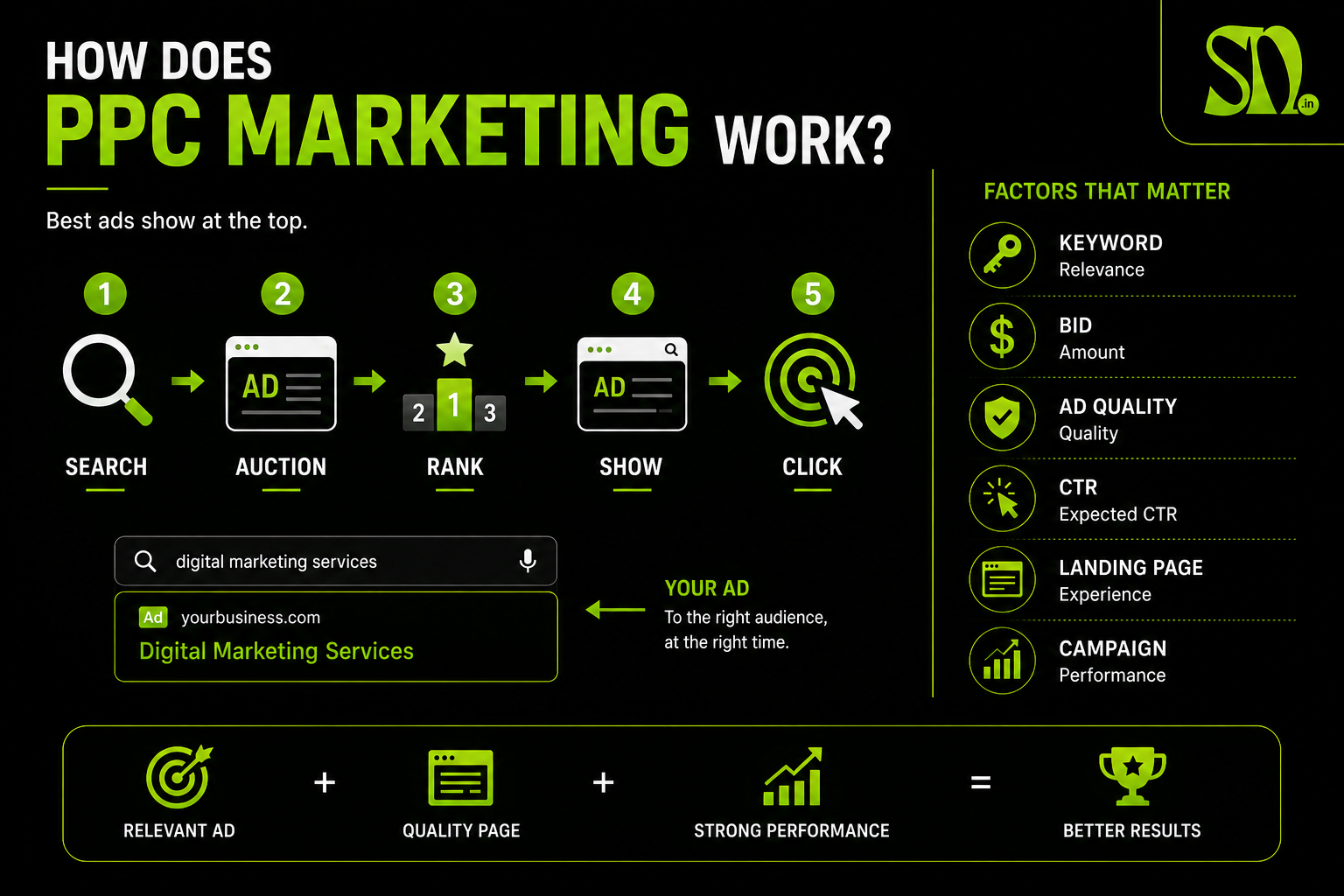
PPC marketing generally works through an advertising auction. When a user searches for a keyword, advertising platforms evaluate eligible advertisements and determine which ads should appear.
The position and performance of an advertisement can depend on several factors, including:
Keyword relevance
Bid amount
Ad quality
Expected click-through rate
Landing page experience
Campaign performance
This means that businesses do not simply need to spend more money to achieve better results. Relevant advertisements and high-quality landing pages can also contribute to stronger campaign performance.
Why Is PPC Marketing Important?
PPC marketing offers several advantages for businesses looking to grow online.
1. Faster Visibility
SEO can take time to build organic rankings. PPC can help businesses gain visibility much faster by placing advertisements in front of targeted users.
2. Targeted Traffic
Businesses can target specific keywords, locations, devices, audiences, and other criteria. This makes it possible to focus advertising on people who are more likely to become customers.
3. Budget Control
PPC platforms allow advertisers to control their spending by setting campaign and daily budgets. Businesses can also adjust budgets based on campaign performance.
4. Measurable Results
PPC campaigns provide detailed data about impressions, clicks, conversions, costs, and revenue. This makes it easier to evaluate marketing performance.
5. Flexible Optimization
Advertisers can continuously improve campaigns by testing different keywords, advertisements, audiences, and landing page
Types of PPC Marketing
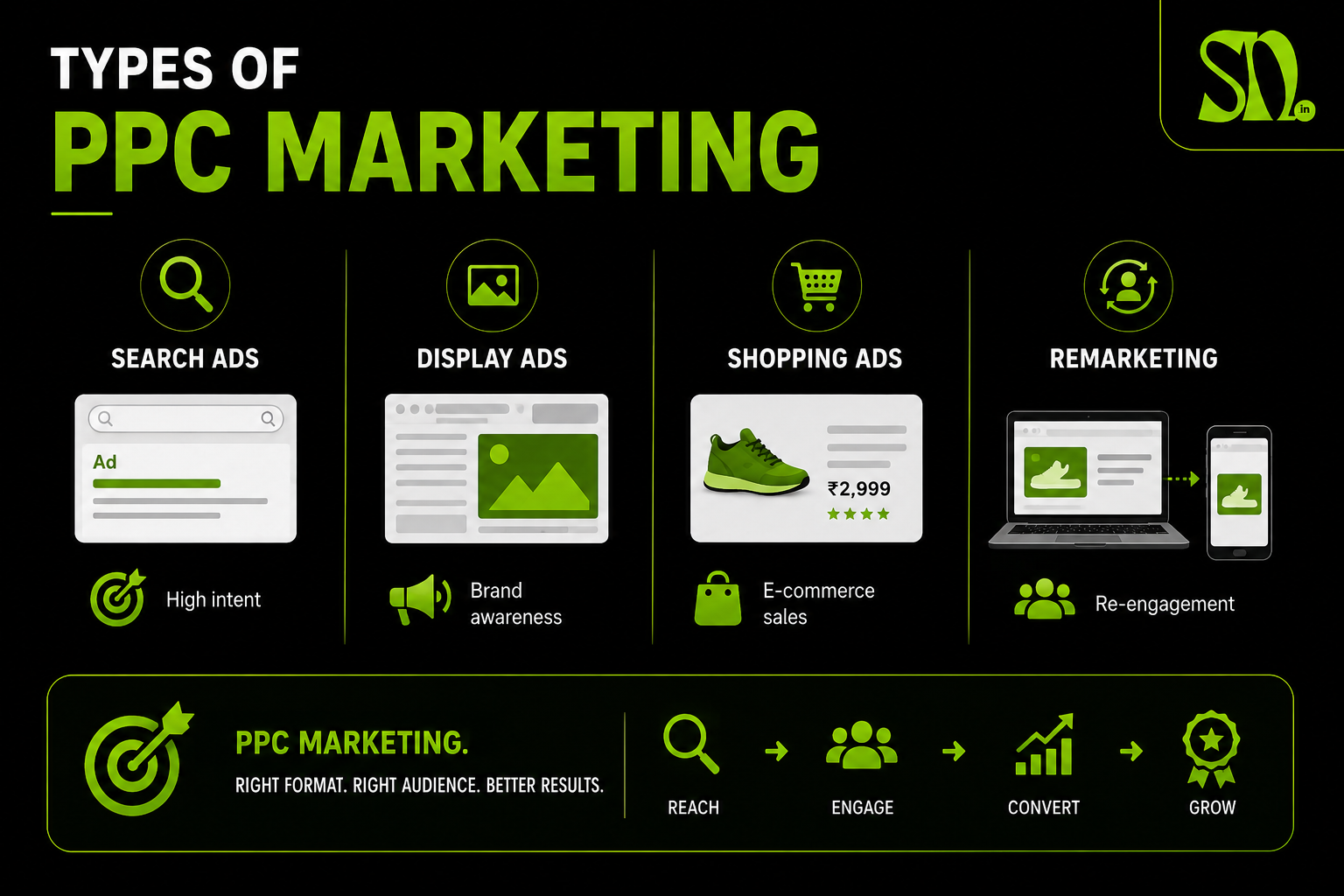
PPC marketing includes several advertising formats.
Search Advertising
Search ads appear when users search for specific keywords. They are particularly useful for reaching people with high purchase or service intent.
Display Advertising
Display ads use images, graphics, or other visual formats and can appear across websites and apps. They are commonly used for brand awareness and remarketing.
Shopping Advertising
Shopping ads are designed primarily for e-commerce businesses. They can display product images, prices, and other product information to potential customers.
Remarketing
Remarketing allows businesses to advertise to people who have previously visited their website or interacted with their brand.
For example, someone may visit an online store and leave without purchasing a product. A remarketing campaign can show that person relevant advertisements later.
PPC Keyword Research
Keyword research is a critical part of PPC marketing.
The goal is not simply to find keywords with high search volume. Businesses should identify keywords that match their products, services, and customer intent.
For example, someone searching for “buy running shoes online” may have stronger purchase intent than someone searching for “running shoes benefits.”
PPC keyword research can include:
Commercial keywords
Transactional keywords
Long-tail keywords
Branded keywords
Competitor keywords
Negative keywords
What Are Negative Keywords?
Negative keywords prevent your advertisements from appearing for irrelevant searches.
For example, if a company sells premium paid software, it may add terms such as “free” as negative keywords if searches containing that term are unlikely to generate customers.
This can help reduce wasted advertising spend.
How to Create a Successful PPC Marketing Campaign
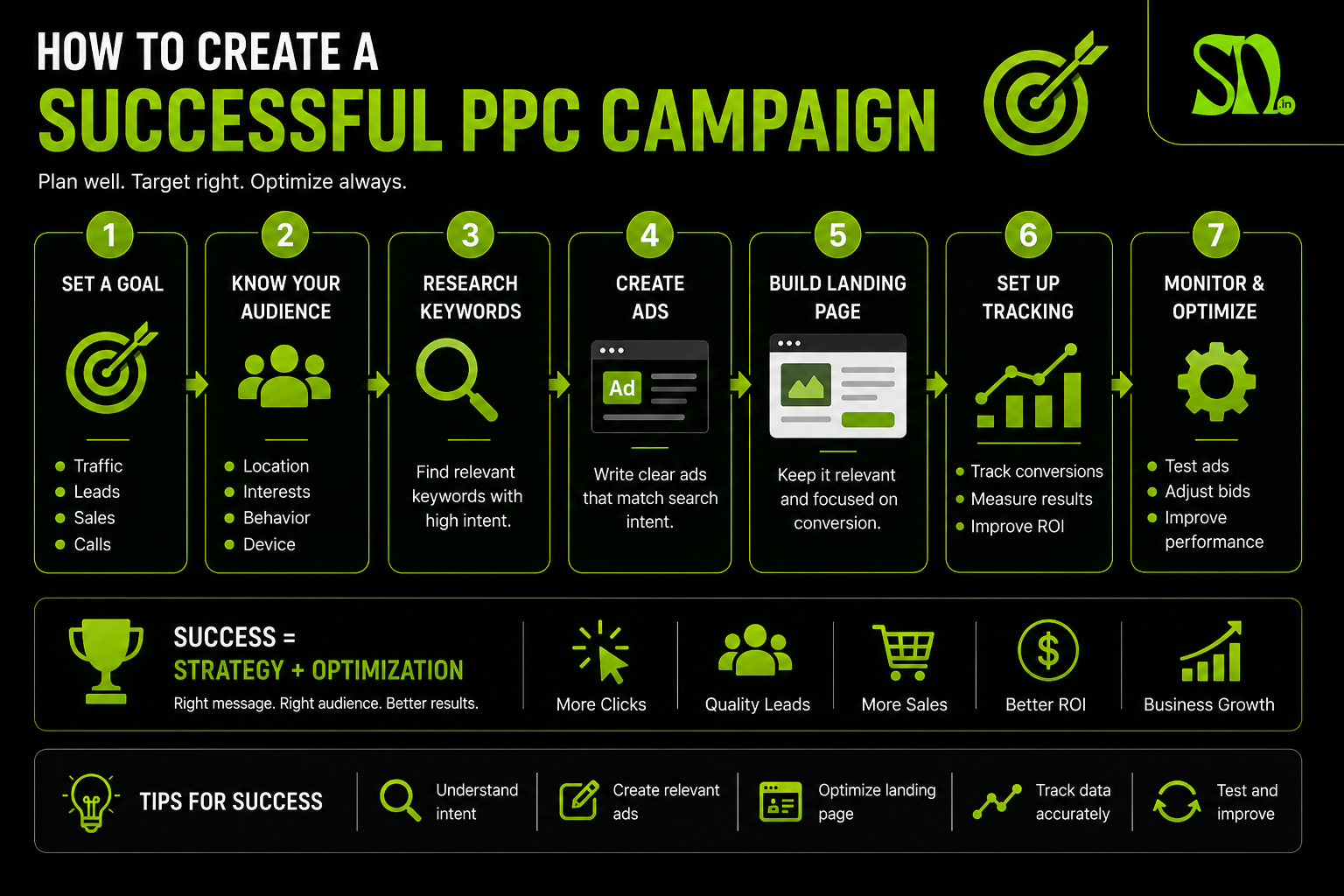
A successful campaign requires careful planning and ongoing optimization.
Step 1: Set a Clear Goal
Start by defining what you want the campaign to achieve.
Possible goals include:
Website traffic
Lead generation
Online sales
Phone calls
Product purchases
Bookings
App downloads
Step 2: Identify Your Target Audience
Understand who your ideal customers are and what they are searching for.
Consider:
Location
Age group
Interests
Search behavior
Purchase intent
Device usage
Step 3: Research Keywords
Choose relevant keywords based on search intent and business goals.
Avoid targeting large numbers of unrelated keywords simply because they have high search volume.
Step 4: Create Relevant Ads
Your advertisement should match the user’s search intent.
Effective PPC ads generally include:
Relevant headlines
Clear benefits
A strong value proposition
A compelling call to action
Step 5: Build a Relevant Landing Page
The landing page should match the advertisement and provide a clear path toward conversion.
For example, if your ad promotes “PPC management services,” the landing page should focus specifically on PPC services rather than sending visitors to a generic homepage.
Step 6: Set Up Conversion Tracking
Conversion tracking allows you to measure whether your advertising is generating meaningful business results.
Conversions may include:
Purchases
Contact forms
Phone calls
Registrations
Bookings
Downloads
Step 7: Monitor and Optimize
PPC marketing is not a one-time activity. Campaigns should be regularly reviewed and optimized.
You can test:
Ad copy
Keywords
Bidding strategies
Landing pages
Audience targeting
Geographic targeting
Budget allocation
Important PPC Marketing Metrics
Understanding PPC metrics helps businesses make better advertising decisions.
Click-Through Rate (CTR)
CTR measures how often people click an advertisement after seeing it.
A higher CTR can indicate that the advertisement is relevant and attractive to the target audience.
Cost Per Click (CPC)
CPC represents the average amount paid for each click.
Conversion Rate
Conversion rate shows the percentage of visitors who complete a desired action after clicking the advertisement.
Cost Per Acquisition (CPA)
CPA measures how much it costs to generate a conversion or acquire a customer.
Return on Ad Spend (ROAS)
ROAS measures the revenue generated in relation to advertising spend.
For example, if a company spends $500 on PPC advertising and generates $2,000 in revenue, the ROAS is 4:1.
PPC Marketing vs SEO
PPC marketing and SEO have different strengths.
PPC marketing can provide faster visibility and immediate traffic, while SEO focuses on building organic visibility over time.
Businesses do not necessarily need to choose between the two. Combining PPC and SEO can create a stronger search marketing strategy.
For example:
PPC can generate immediate traffic.
SEO can build long-term organic visibility.
PPC data can help identify valuable keywords.
SEO content can support users throughout the buying journey.
Common PPC Marketing Mistakes
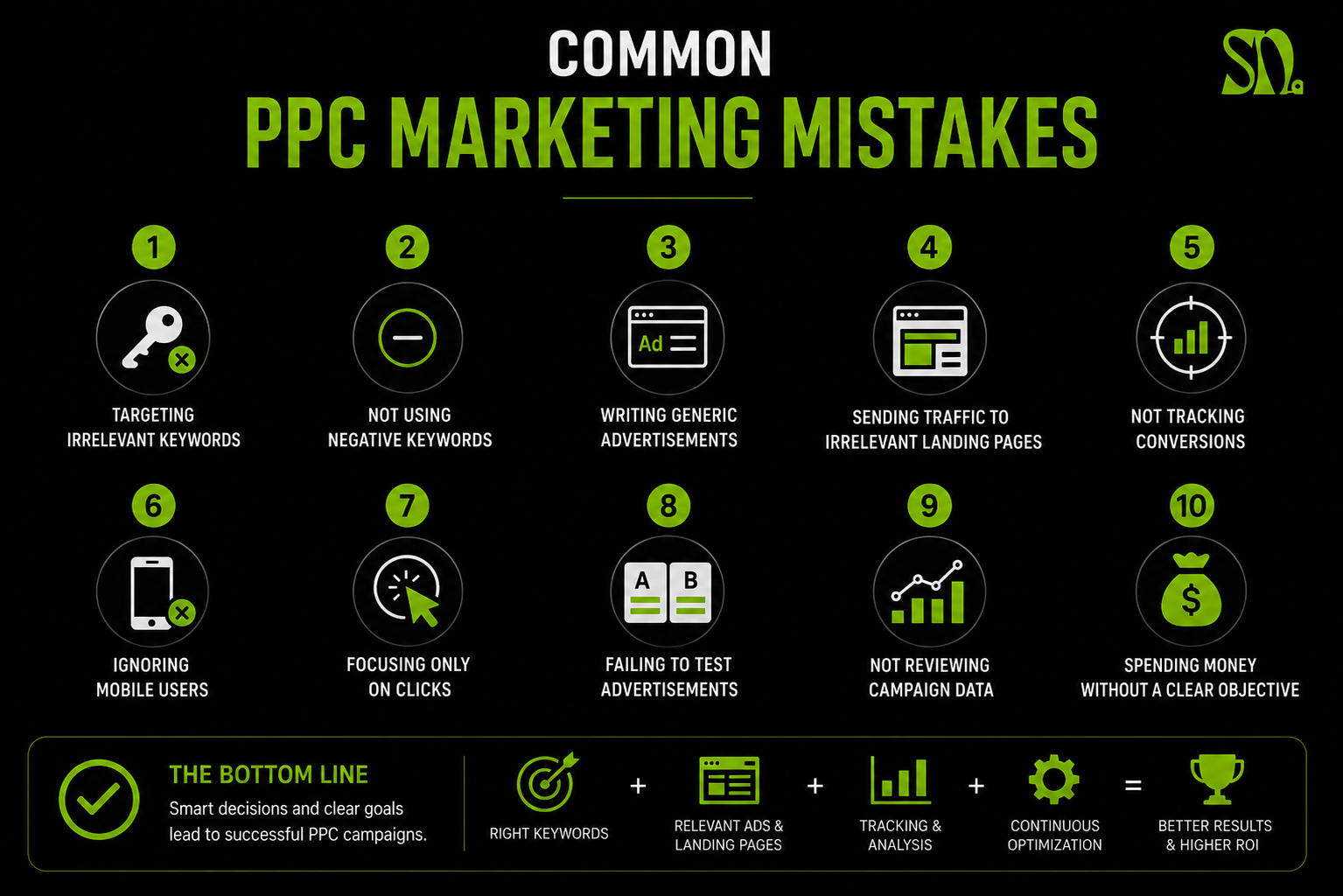
Poor campaign management can lead to wasted advertising budgets.
Some common mistakes include:
Targeting irrelevant keywords
Not using negative keywords
Writing generic advertisements
Sending traffic to irrelevant landing pages
Not tracking conversions
Ignoring mobile users
Focusing only on clicks
Failing to test advertisements
Not reviewing campaign data
Spending money without a clear objective
Avoiding these mistakes can help businesses improve PPC efficiency and maximize advertising results.
PPC Marketing Best Practices
To get better results from PPC marketing, businesses should:
Focus on user search intent.
Use highly relevant keywords.
Create specific ad groups and campaigns.
Write clear and compelling ad copy.
Use negative keywords.
Optimize landing pages.
Track conversions accurately.
Test different advertisements.
Monitor campaign performance regularly.
Optimize based on business results rather than clicks alone.
The Future of PPC Marketing
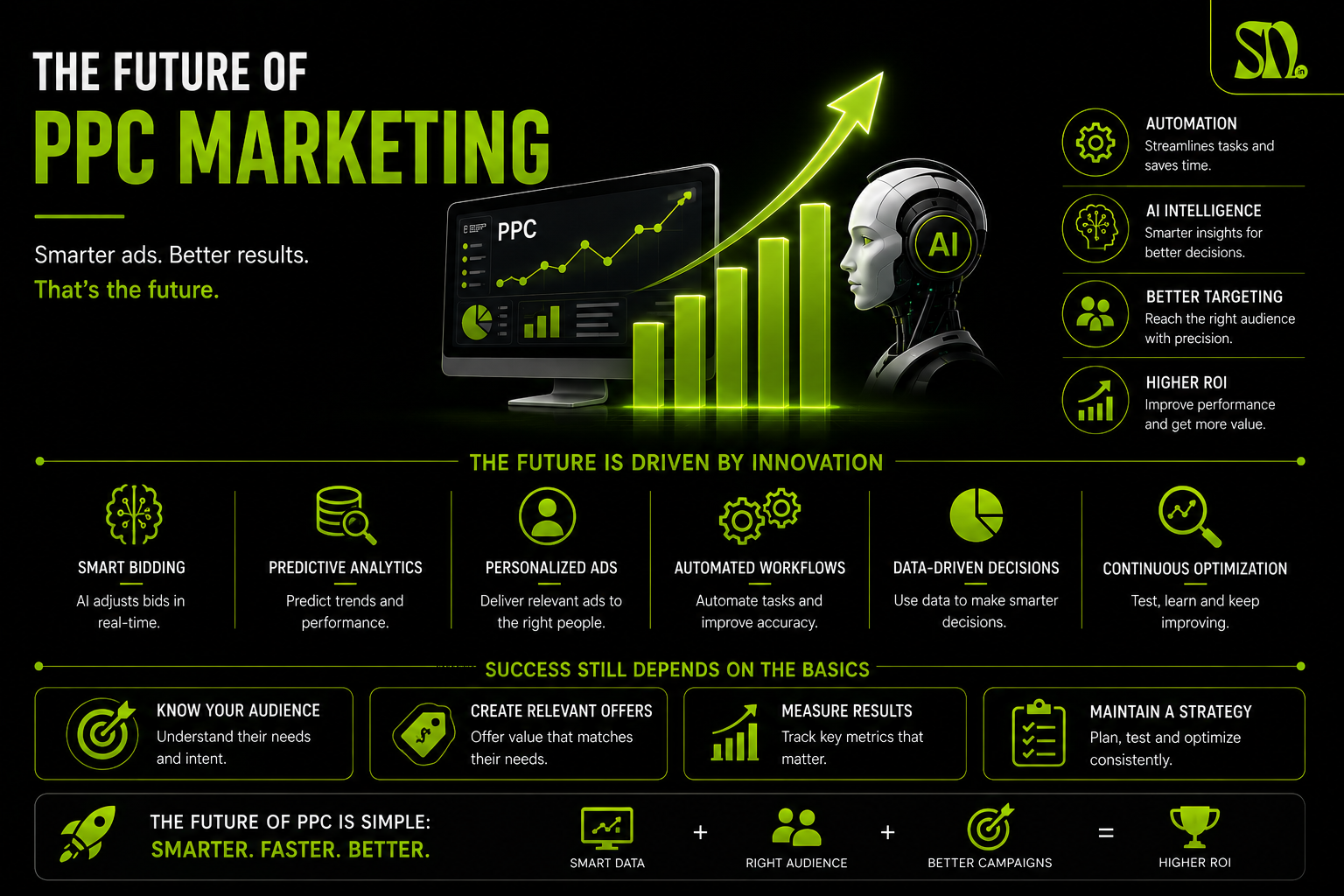
PPC marketing continues to evolve as advertising platforms introduce automation, artificial intelligence, advanced audience targeting, and improved campaign optimization.
AI and automation can help marketers analyze large amounts of data, identify patterns, personalize advertising experiences, and optimize campaigns more efficiently.
However, successful PPC marketing still depends on understanding customer intent, creating relevant offers, measuring business outcomes, and maintaining a clear advertising strategy.
Conclusion
PPC marketing is a powerful digital advertising strategy for businesses that want to reach targeted customers, generate leads, and increase sales. Its biggest advantages include fast visibility, precise targeting, measurable performance, and flexible budget management.
However, simply running advertisements does not guarantee success. Effective PPC marketing requires keyword research, relevant ad copy, optimized landing pages, accurate conversion tracking, and continuous campaign optimization.
When PPC is combined with SEO, content marketing, analytics, and conversion rate optimization, it can become an important part of a complete digital marketing strategy.
FAQs
What is PPC marketing?
PPC marketing is a form of digital advertising where advertisers pay when users click on their advertisements.
Is PPC marketing good for small businesses?
Yes. Small businesses can use PPC marketing to target specific locations, keywords, and audiences while controlling their advertising budgets.
How much does PPC marketing cost?
There is no fixed cost. PPC costs depend on factors such as keyword competition, industry, audience, location, bidding strategy, and campaign quality.
How long does it take for PPC marketing to work?
PPC campaigns can start generating traffic soon after advertisements become active, but achieving consistent and profitable results usually requires ongoing testing and optimization.
Is PPC better than SEO?
Neither is universally better. PPC can provide faster visibility, while SEO can build long-term organic traffic. Using both together can provide complementary benefits.